

You have an idea. Maybe it solves a problem you’ve experienced firsthand, improves an existing product, or creates a new opportunity. The next question is: how do you turn that idea into a real business?
The path from concept to first results can feel overwhelming. But you don’t need to have every answer from day one. What matters most is testing whether the idea has real potential, understanding what resources you’ll need, and moving forward through small, deliberate steps.
Define your idea
Start with a simple four- or five-slide presentation. This isn’t an investor pitch deck. It’s a way to clearly define what you’re building and why it matters.
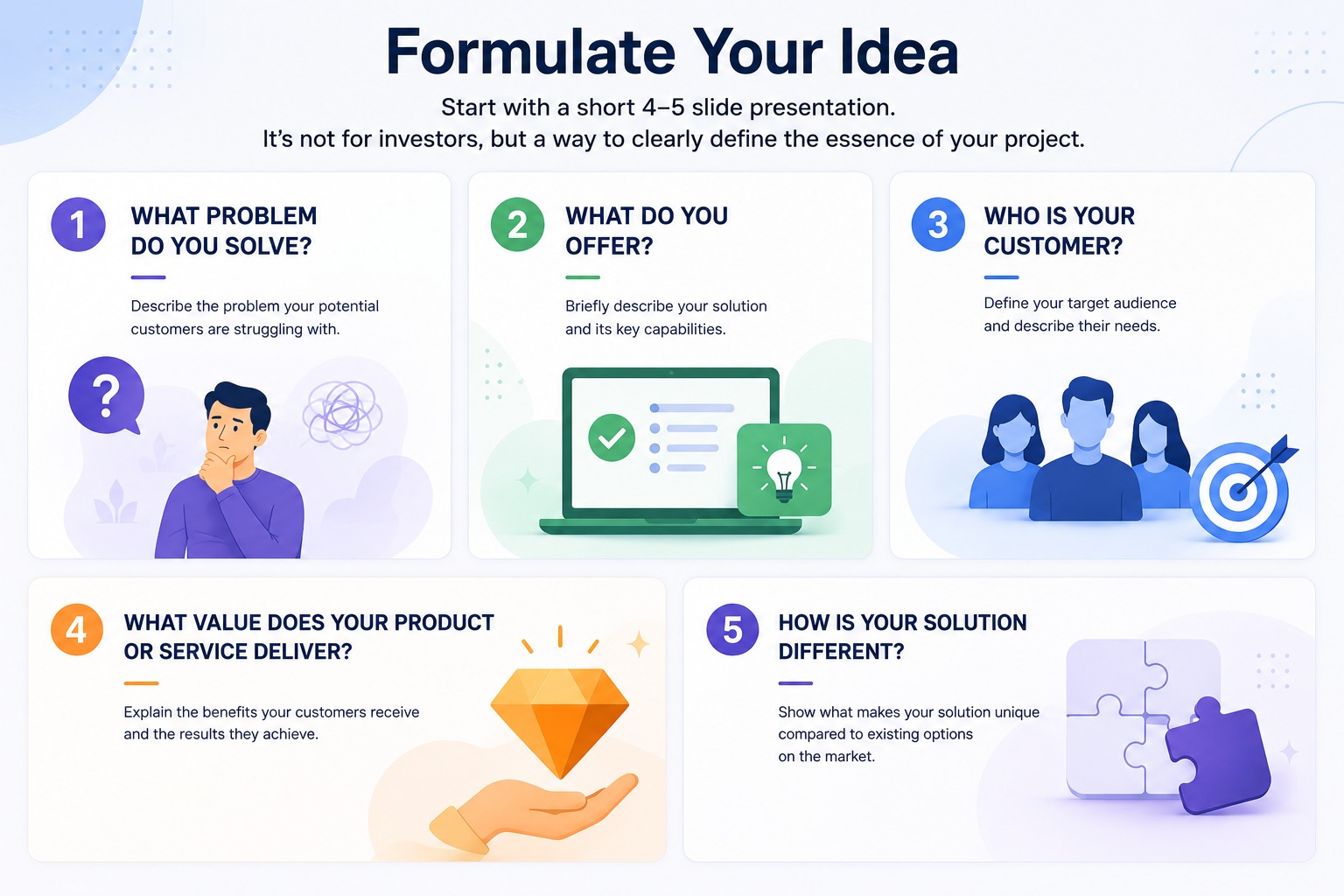
Answer a few basic questions:
- What problem are you solving?
- What exactly are you offering?
- Who is your customer?
- What value does your product or service provide?
- How is your solution different from what already exists?
The most important question is: Why does the market need this business?
When comparing your idea with competitors, don’t focus only on features. Your solution may be faster, simpler, more affordable, more convenient, or more effective. If you can’t explain its value in a few sentences, the concept probably needs more work before you make a significant investment.
Identify the resources you’ll need
Make a list of what it will take to launch: people, equipment, software, manufacturing, intellectual property protection, licenses or certifications, legal support, funding, and marketing.
Then determine what you already have, what you can realistically handle yourself, and what should be outsourced to professionals.
Avoid building everything upfront. Doing so can drive up costs before you’ve confirmed that customers actually want the product.
Build a simple prototype
Your first prototype doesn’t need to look like a finished product. Its purpose is to test your most important assumption and help people understand what you’re offering.
Depending on the business, your prototype might be a landing page, an interactive mockup, a 3D model, a sample made from inexpensive materials, or even a service you initially deliver manually.
At this stage, feedback matters more than perfection. Once potential customers can see or experience something tangible, they can give you much more useful feedback about their needs, concerns, and objections.
Decide what to do yourself
There’s no need to do everything on your own—but outsourcing too much too early can also be a mistake.
You can often handle competitor research, customer interviews, and early marketing-message testing yourself. More specialized work, such as complex engineering, legal matters, manufacturing, or advanced software development, may be better left to experienced professionals.
Instead of asking only, “Can I do this myself?” ask: “Is this the best use of my time, and what happens if I get it wrong?”
Test the business economics
You don’t need a perfect financial model at the beginning, but the basic numbers need to make sense.
Estimate the costs of product development, manufacturing or service delivery, shipping, marketing, customer support, and other operating expenses. Then compare those costs with the price customers are actually willing to pay.

A viable business needs two things to be true: customers want the product, and selling it generates enough revenue and margin to support a sustainable company.
Think beyond the launch
Your first customer is only the beginning. Think ahead about what growth could require. Will you need additional employees, inventory, suppliers, distribution partners, new sales channels, or more working capital?
Consider your potential funding sources as well: personal savings, revenue from customers, grants, bank or SBA-backed loans, angel investors, or venture capital.
It’s important to understand not only how much money you may need, but when you’re likely to need it.
In the United States, early-stage entrepreneurs can also find support through organizations such as the U.S. Small Business Administration (SBA), Small Business Development Centers (SBDCs), SCORE, local business incubators, and startup accelerators. These organizations may offer mentoring, training, business-planning assistance, and guidance on financing opportunities.
A successful business rarely starts with a perfect idea. It starts with testing assumptions, using resources wisely, learning from real customers, and being willing to adjust your approach as new information comes in.