

Expanding into new markets helps businesses grow, increase revenue, and reduce reliance on a single revenue stream. However, expansion requires preparation: it’s important to assess demand, competition, audience characteristics, and potential risks.
Why you should look for new markets
New markets provide access to additional revenue streams and a broader customer base. At the same time, they make your business more resilient — reducing dependence on a single segment makes it easier to weather fluctuations in demand. Scaling into new markets can lower per-unit costs, while engaging with new audiences can drive product development and boost brand awareness.
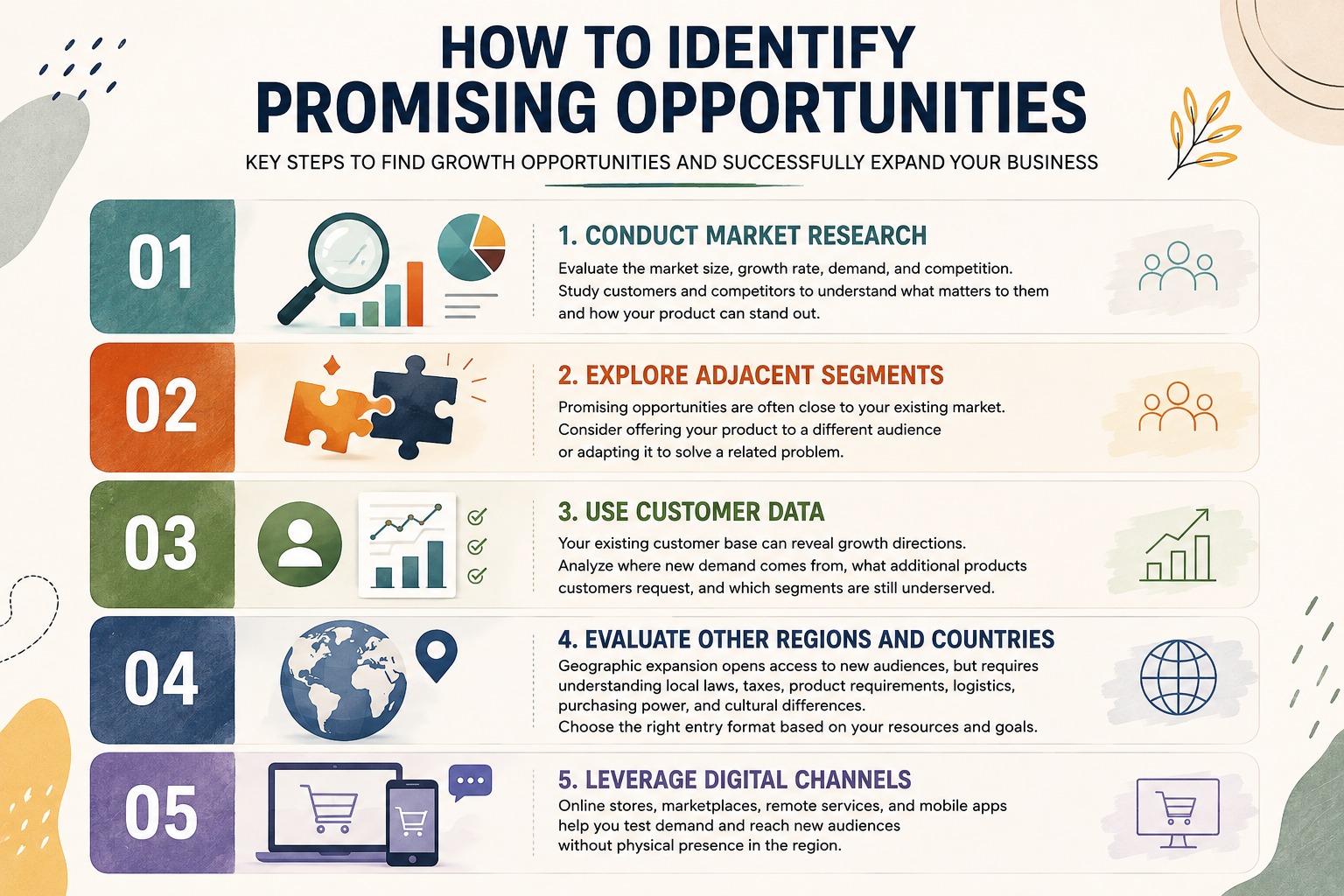
How to identify promising opportunities
Before entering a new market, it’s important to understand where growth potential actually lies. Here are the key steps to help you identify the most promising areas for expansion.
1. Conduct market research
Evaluate market size, growth rate, demand, and the level of competition. Study buyer behavior: what matters to them, what problems they’re trying to solve, and what needs are going unmet.
Identify your main competitors and their strengths and weaknesses. This will help you understand how your product can stand out.
2. Explore adjacent segments
Promising opportunities are often found close to your existing market. Consider whether you can offer your current product to a different audience or adapt it to address a related need.
For example, a manufacturer of hiking gear might expand its product line into camping or adventure travel.
3. Use customer data
Your existing customer base can often point you toward new growth opportunities. Analyze which regions and industries are generating new demand, what additional products customers are requesting, and which customer segments are currently underserved.
For example, consistent interest from businesses in a food delivery service could be a strong signal to launch a corporate catering offering.
4. Evaluate other regions and countries
Geographic expansion opens the door to new audiences, but it requires a solid understanding of local nuances. Research local regulations, taxes, product requirements, logistics, purchasing power, and cultural differences.
The right market entry model will depend on your resources and goals. Options include direct sales, working through a local partner, franchising, licensing, or establishing your own local presence.
5. Leverage digital channels
An online store, marketplaces, remote services, and mobile apps can help you test demand and reach new audiences without a physical presence in the region.
How to enter a new market
Entering a new market requires a clear strategy and a step-by-step approach. Here are the key methods to help make the process manageable and effective.
Choose the right model
Direct sales give you more control, partnerships speed up access to local knowledge and distribution channels, and franchising or licensing allows you to scale with lower upfront investment. Acquiring an existing company provides fast market entry, but requires significant investment and thorough due diligence.

Adapt your offering
Your product, pricing, packaging, and marketing messaging should reflect the expectations of your new audience. Simply translating your materials isn’t enough — your offering needs to be tailored to local habits, income levels, and regulatory requirements.
Find local partners
A local partner can help with sales, logistics, marketing, and navigating government processes. Working with a well-known local company can also help you build brand trust more quickly.
Align your marketing and sales strategy
Identify where your target audience looks for information and makes purchasing decisions. This could include search engine optimization, social media, marketplaces, retail networks, distributors, or direct sales.
Track your results
After launching, monitor revenue, customer acquisition cost, conversion rates, repeat purchases, retention, and market share. Gather feedback and compare actual results against your expectations.
Entering a new market rarely goes exactly according to plan. The faster a company spots shifts in demand and adjusts its approach, the better its chances of turning a new market into a sustainable source of growth.