

A successful business does not always begin with a technological breakthrough or a large amount of start-up capital. Sometimes it is enough to look at a familiar problem from a different angle, change the way an existing product is sold, or offer customers a more convenient way to use it. That is why the world’s most interesting business ideas often seem surprisingly simple once they become widespread. Their value lies not so much in the originality of the concept as in how precisely they meet the needs of their target audience.
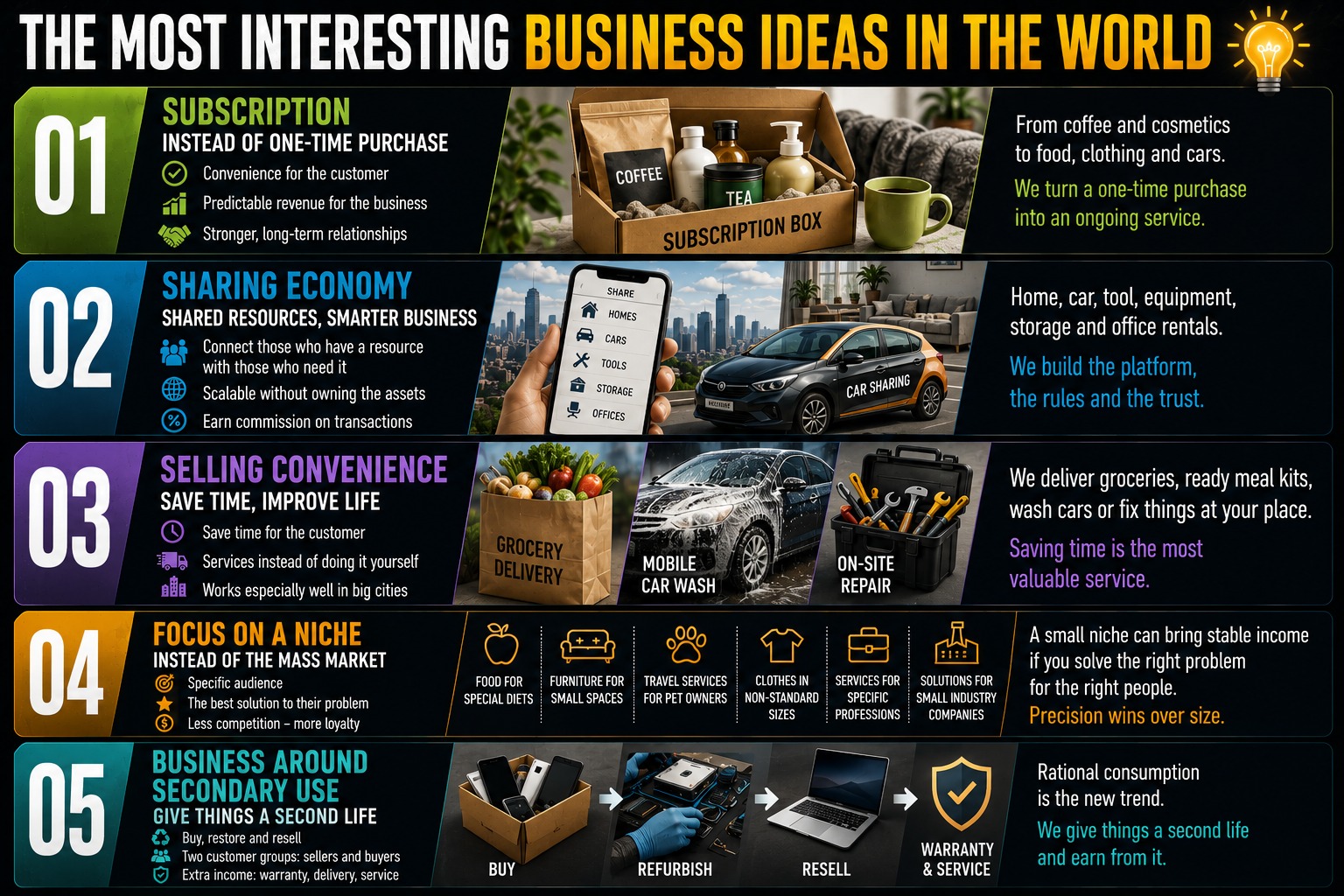
Subscription instead of a one-time purchase
The subscription model has long moved beyond magazines and online services. Today, subscriptions are used to sell coffee, cosmetics, ready-made meals, pet products, clothing, and even cars. For customers, the main advantage is convenience. The product they need arrives regularly, without requiring them to place the same order manually each time.
For businesses, this model is valuable because it provides more predictable revenue and helps build longer-term relationships with customers. Many of the world’s interesting business ideas have grown precisely because entrepreneurs turned an ordinary one-time purchase into an ongoing service.
The sharing economy
Airbnb and short-term rental services have shown that businesses can make money without selling products they own themselves. A platform connects people who have an unused resource with those who need access to it for a limited period. The same principle is used in car sharing, as well as in the rental of tools, equipment, storage space, and workplaces.
The main advantage of this model is the ability to scale without having to own every asset directly. The company establishes the rules, provides payment infrastructure, creates search and matching tools, and builds trust between participants while earning a commission on transactions.
Selling convenience
Some successful businesses are built around tasks that people could theoretically handle on their own. Grocery delivery, meal kits, mobile car washing, and on-site repair services primarily sell one thing: time savings.
This model works particularly well in large cities, where an extra hour can have significant value. The world’s most successful business ideas are often based on exactly this principle: instead of creating an entirely new product, an entrepreneur makes an existing service faster, simpler, or more accessible.

A narrow niche instead of the mass market
Trying to sell “to everyone” often means competing directly with large established companies. For a small business, it can be more profitable to focus on a specific audience and solve its particular problem better than general-purpose providers do.
Examples of niche markets include:
- food for people with specific dietary restrictions;
- furniture designed for small apartments;
- travel services for pet owners;
- clothing in non-standard sizes;
- specialized services for particular professions;
- equipment and software for small companies in specific industries.
A niche may be relatively small, but a highly targeted offer increases the likelihood of repeat purchases and can reduce marketing costs.
Businesses built around reuse
Growing interest in more responsible consumption has created an entire market for resale and refurbishment. Companies buy used smartphones, laptops, furniture, clothing, or industrial equipment, restore them, and put them back on the market.
This model allows a business to serve two groups of customers at once: people who want to sell unwanted items quickly and those who want to buy products at a lower price than new ones. Additional revenue can come from repairs, warranties, delivery, and extended service packages.