

Starting your own business without significant start-up capital is possible if, at the initial stage, you sell your skills, time, or access to useful information rather than physical products. When considering how to start a business with no investment, it is important to abandon the idea that launching a business can be completely free. You may not need money, but you will still have to invest time, look for clients, and handle a large share of the work yourself. The main goal at the beginning is to secure your first orders before taking on recurring expenses.
Services as the simplest option
A service-based business usually requires less money to start than retail or manufacturing. Copywriting, design, advertising setup, consulting, equipment repair, tutoring, or social media management can all be launched without renting an office or purchasing inventory.
Such business ideas with no investment are also convenient because they make it possible to test demand almost immediately. All you need to do is define your offer, find several potential clients, and see whether they are willing to pay for it. If there is no demand, you can adjust the business model without losing money already invested in equipment or stock.
Acting as an intermediary without your own product
It is also possible to earn money by organizing transactions between clients and service providers. The entrepreneur finds a customer, passes the job on to a specialist, and earns a commission. Small agencies in home repairs, cleaning, transportation, recruitment, and event planning often operate according to this model.
For those deciding what business to start with no investment, this approach makes it possible to rely on sales and communication skills instead of capital. However, the responsibilities of each party should be clearly defined in advance. If a contractor misses a deadline or performs the work poorly, the customer will often direct their complaints to the person who arranged the deal.
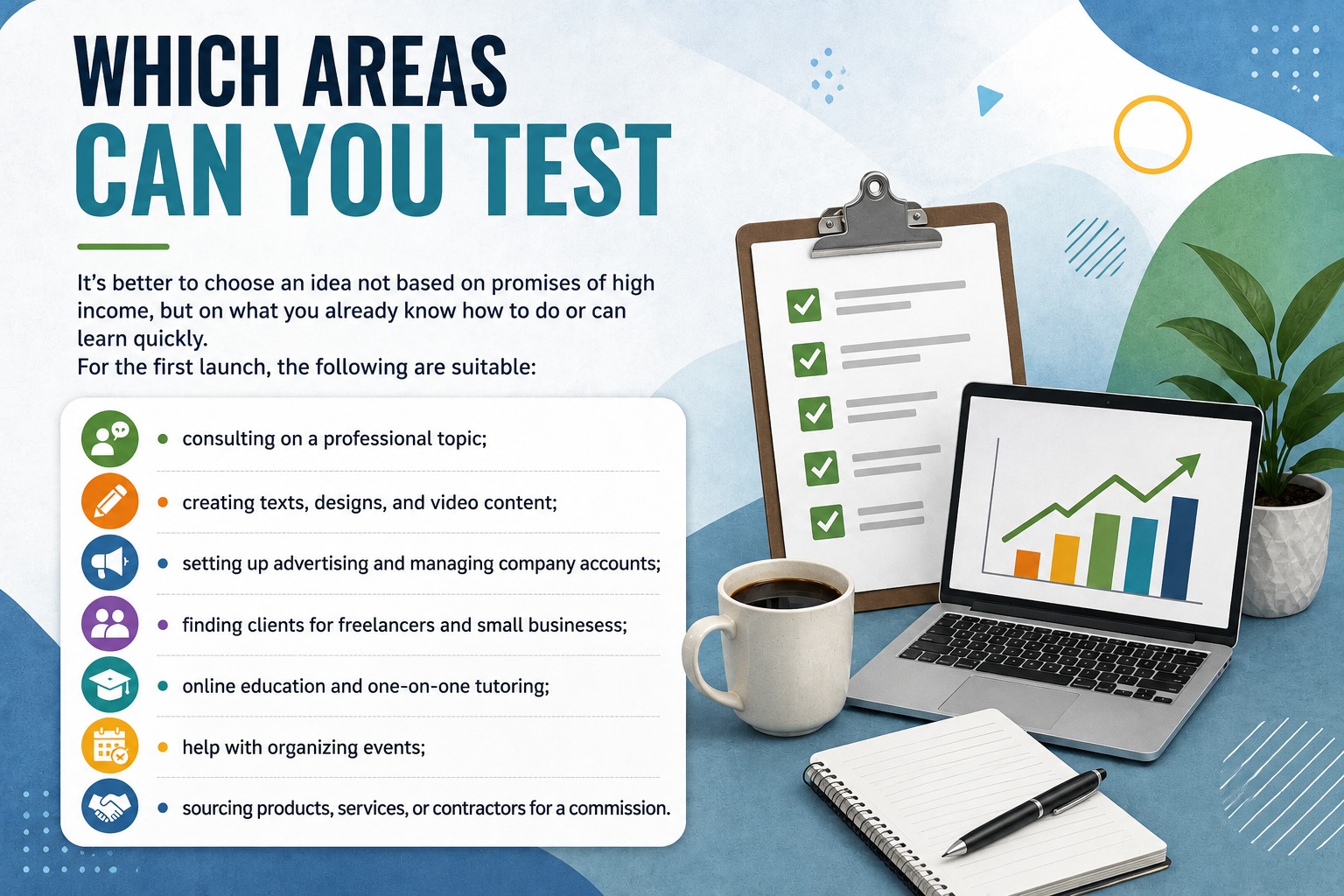
Business ideas you can test
It is better to choose an idea based not on bold income promises, but on what you already know how to do or can learn quickly. Suitable options for a first launch include:
- consulting in an area of professional expertise;
- creating written, graphic, or video content;
- setting up advertising campaigns and managing business accounts;
- finding clients for tradespeople and small companies;
- online teaching and one-to-one tutoring;
- helping organize events;
- finding products, services, or contractors in exchange for a commission.
These business ideas without financial investment are easier to test in small steps. There is no need to immediately register a complicated business structure, hire employees, or pay for premises. First, you can make sure that the offer actually attracts interest and only then expand your operations.
Where to find your first clients
The main challenge of starting a business without capital is having limited access to paid advertising. That is why personal contacts, referrals, and direct outreach are especially important at the beginning. The first projects often come through friends and acquaintances, professional communities, industry-specific chats, and freelance platforms.

You can also create a list of companies that may need your service and contact them directly. Instead of sending the same generic message to hundreds of recipients, it is better to briefly explain what specific problem you can solve for each company. Even a few responses can provide more useful information about demand than weeks spent preparing an abstract business plan.
Do not rush into spending
After receiving the first few orders, it can be tempting to immediately:
- buy expensive equipment;
- pay for premium subscriptions;
- rent a workspace.
At an early stage, such expenses often reduce the business’s financial safety margin without increasing revenue. A more sensible approach is to reinvest part of the money earned only in tools or resources that genuinely allow you to handle more orders or improve the quality of your work. If a free tool is still sufficient, there is little reason to replace it with a paid one simply to make the business feel more “professional.”