

High profitability depends less on the industry itself than on the combination of demand, margins, and the ability to control costs. That is why there is no single universal answer to the question, what is the most profitable business. In one region, an auto repair shop may perform well; in another, delivery services, IT, or small-scale manufacturing may be more successful. It is more useful to evaluate the business model itself: how much it costs to acquire a customer and how much revenue remains after all expenses.
Why high revenue does not mean high profit
Large sales volumes say little about the actual financial result. A store may sell millions worth of goods while spending almost all of its revenue on suppliers, logistics, rent, and employees. A smaller service company with more modest sales can sometimes leave its owner with significantly more profit.
That is why profitable business ideas usually have strong unit economics. The higher the margin, the lower the fixed costs, and the greater the number of repeat purchases, the more sustainable the model tends to be. Businesses are particularly attractive when revenue can grow without requiring a proportional increase in staff or inventory.
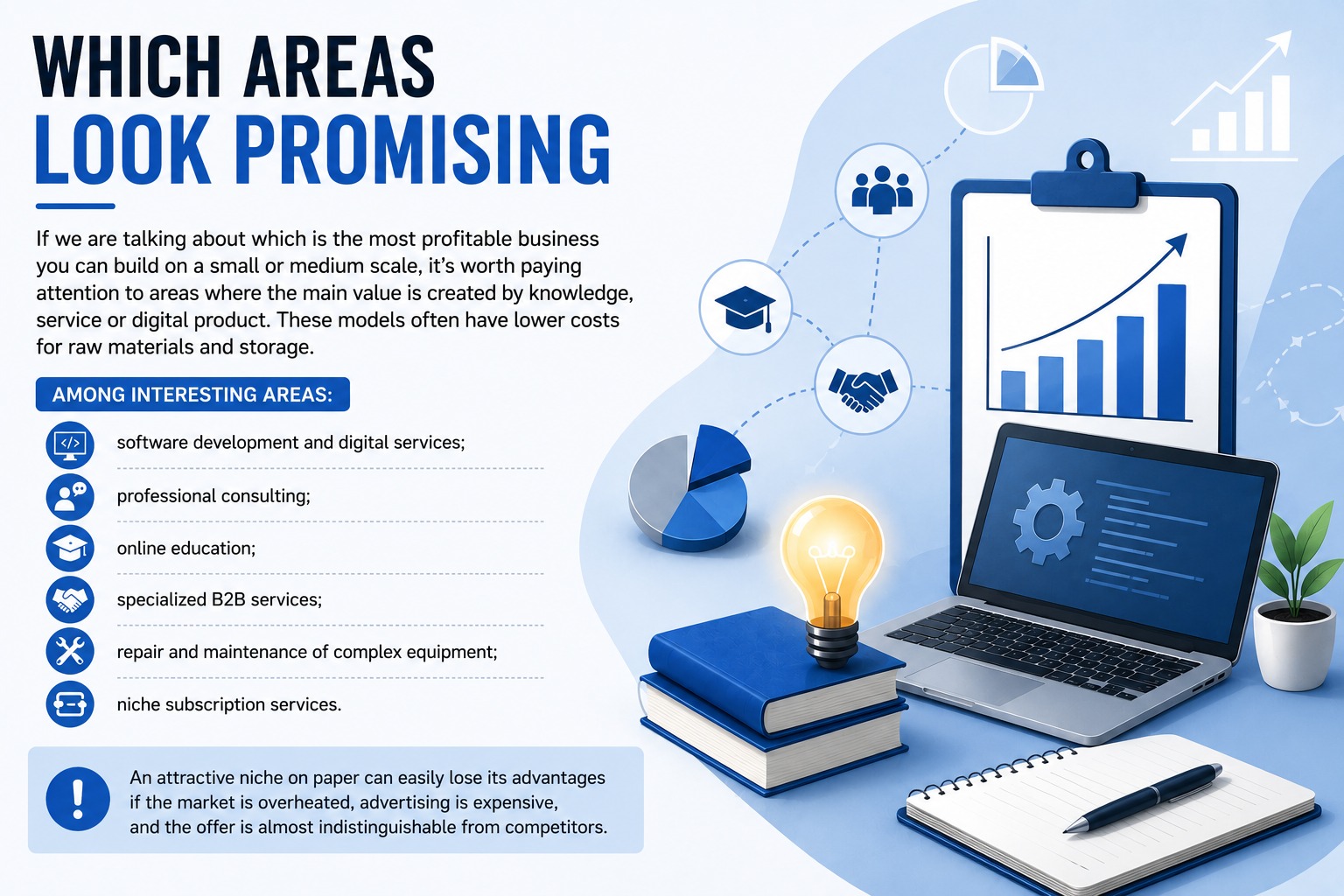
Which areas look promising?
When considering what the most profitable business might be on a small or medium scale, it is worth looking at sectors where most of the value comes from expertise, service, or a digital product. These models often have lower costs for raw materials, inventory, and storage.
Promising areas include:
- software development and digital services;
- professional consulting;
- online education;
- specialized B2B services;
- repair and maintenance of complex equipment;
- niche subscription services.
However, a niche that looks attractive on paper can quickly lose its advantages if the market is overcrowded, advertising is expensive, and the offer is almost indistinguishable from competitors.
Repeat sales can transform the economics
One of the strongest drivers of profitability is the ability to earn revenue from the same customer more than once. Maintenance contracts, subscriptions, recurring deliveries, and long-term support make it possible to avoid paying the same customer acquisition cost for every new sale.
That is why, when deciding which business is profitable, it is important to consider how frequently customers need the product or service. A large one-time transaction can generate good income, but it also requires a constant search for new buyers. A business with a lower average order value may ultimately be more profitable if customers return every month.
Low fixed costs provide a safety margin
A profitable business does not necessarily have to look large. A downtown office, a large staff, and a private warehouse may create the impression of a serious company, but they also raise the break-even point. When demand falls, fixed expenses can quickly consume the company’s profits.
That is why many businesses maintain a flexible cost structure by:
- renting capacity only when needed;
- outsourcing some tasks to contractors;
- avoiding premature expansion of the workforce.
This makes it easier to withstand seasonal downturns and test new business areas at a lower cost.
Competition matters more than how trendy a niche is
When a new market receives a lot of attention, large numbers of entrepreneurs quickly enter it. Strong demand does not automatically mean high profits if dozens of similar companies are competing for every customer.

Narrower markets can often be more attractive when there is a clear problem but not enough strong solutions. This might involve maintaining a particular type of equipment, developing software for a specific industry, or providing a specialized service to businesses. The potential audience may be smaller, but companies can compete through quality and expertise rather than price alone.
What should be considered a truly profitable business?
A business idea should be evaluated according to:
- profit margins;
- payback period;
- repeat sales;
- fixed operating costs;
- dependence on a single customer acquisition channel.
It is also important to understand how easily competitors can copy the offer. The strongest business models are those where the customer’s problem occurs regularly, the company solves it better than available alternatives, and every transaction generates enough profit to support further growth. For this reason, it is more useful to search for profitable opportunities by calculating the economics and testing real demand than by relying on rankings of supposedly lucrative niches.